
 Most bad customers are not really bad customers. They’re just bad customers for you. They’re a bad fit. And it’s your fault.
Many businesses don’t want to miss out on any sales opportunity, so they say they can do everything. They don’t want to define themselves and risk losing a customer. So the poor customers are out there trying to comparison shop and everyone looks the same. So they take a stab at it and sometimes they guess wrong. Which means you have a bad customer on your hands.
Think of all the jewelry stores you can. Now, think of their advertising and positioning. Pretty much the same, aren’t they? Love, romance, tell her how much you love her…etc. etc. etc.
Now picture their actual stores. They blend together, don’t they? The merchandise is about the same; the clerks are about the same. They don’t make a point of standing out.
So how can a consumer tell if they’re a good fit? They can’t. Hello bad customer.
But there are a few who actually have the courage to stand out from the pack.
Let’s look at Tiffany & Co. first. The infamous blue box. And the staggering price tags.
Do you think some people opt not to shop at Tiffany because of their brand? You bet. Is that Tiffany’s loss? I don’t think so. They have saved themselves a lot of staff time and effort, all to end up with either an unhappy customer or someone who walks away, thinking they had a bad experience.
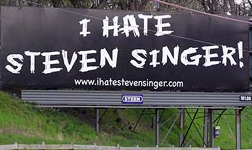
Change the channel and let’s look at Steven Singer Jewelry in Philly. (It’s worth it to let the whole page load…wait for the change.) Singer asked himself what do 21-30 year old guys want? How about lingerie-clad women wading through bubbles?
He’s betting that he’s right. Their promotions include in store bubble bath parties (yes, complete with scantily-clad women), chicken wing eating contests and giveaways on Howard Stern’s radio show.
Steven Singer Jewelers is proving that you don’t have to look or sound like a Harlequin novel to sell diamonds.
He started out with the billboards “I hate Steven Singer” throughout the metro. That drove people to the website, where they read stories from men who hated Steven Singer because they had to give up their great bachelor lives and now they’re married.
Same product category. Two very distinct brands in a sea of generic competitors. Do you think that helps sales? Does it filter out the wrong customers?
Can you imagine a Tiffany customer in Singer’s store? Of course not. That’s the point. They just shortcut right to the store that fits them and have a buying experience that met their needs.
How many bad customers could you avoid if your brand shouted loud and clear above your generic competitors?

Like Matt, I enjoyed your article too.
There’s no such thing as a bad customer, just a bad salesperson.
Could not agree more, especially in the current environment with paid search. Not fully understanding who your customer leads to huge acquisition costs.
Great article, Drew. A good reminder that all businesses should repeat the mantra, “Know thy customer,” and that small businesses, in particular, can blow the competition out of the water by knowing their customer better than everyone else!
Great article! This is something I am struggling with right now as I LOVE internet marketing and all things related to it.
I’ve recently had my website reviewed and it’s really opened up the fact that I am not targeting a specific client, and therefore those who come to my site won’t know WHAT to hire me for.
I’ll definitely be working on this one 🙂
Angela Wills
http://www.StarVA.com
We get into trouble when we don’t find out what the customer’s expectations are. We have to be very clear with ourselves first, and communicate that clarity to our customers. Unspoken assumptions can lead to a really bad fit, but a good brand presence can head that off. Thanx for the article, Drew!
On the other side of the coin are companies who identify bad customers after the relationship has been deemed undesirable. Sprint caught a lot of bad PR recently when they sent a form letter to a large group of customers telling them they obviously could not meet their needs based on frequent, unresolved customer service calls. Therefore, Sprint terminated their wireless contract with those “difficult” customers. I wrote about it here:
http://www.marketingblurb.com/2007/07/1_way_to_lose_customers.html
There is value to determining if a customer is not right for your business early on rather than suffer negative consequences later. In small business, it’s especially difficult to say no to a potential customer, but sometimes, a short term loss can lead to long term gains.
Pingback: Search Engine Optimization Journal » How To Brand Yourself Online Or Offline
If you’re offending someone… then your marketing is working!
Pingback: How to attract and manage novice clients
Pingback: Startup Signal - Today’s Top Blog Posts on Entrepreneurship - Powered by SocialRank
Pingback: Small Business Radar - Today Top Blog Posts on Small Business - Powered by SocialRank
Saying that the customer is the problem is such a nice way to get bankrupt.
Nice post!
Very useful. I had a similar experience with a customer that came to my store, a couple of weeks ago. If I could just read this post then, I would know how to deal with him better.. 🙂